Home » Game Coverage, Personnel, Statistics

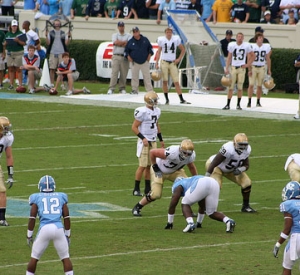
They Call It Powder Blue, Irish vs. Tar Heels News and Notes

By Anthony Pilcher · October 15th, 2008 · 9 Comments · 421 views
1 Star2 Stars3 Stars4 Stars5 Stars
They Call It Powder Blue, Irish vs. Tar Heels News and Notes

You Call That A Tendency?

Charting the Irish offense from Saturday’s game against North Carolina leads to a painful—yet obvious—conclusion: Notre Dame offensive coordinator Mike Haywood telegraphs the pass. It is puzzling how the Irish still managed 383 yards through the air, a testament to the talent Notre Dame has on offense.

Disclaimer: The following analysis excludes the first two drives of the game (11 plays). I was unable to analyze this due to broadcasting/programming issues. Additionally, sacks were not counted as rushing attempts and the lost yardage from sacks wasn’t included in this analysis. It is expected that these 11 plays and the four sacks will not significantly alter the analysis or conclusions of said analysis.

Out of convenience I will use the personnel grouping nomenclature found here. The Irish ran only five personnel groupings against the Tar Heels: Jax, Half, Regular, Two Tites, and Goal Line. Nota Bene: multiple formations can be run out of each personnel grouping. These groupings merely denote which players take the field, not the formation used by the offensive coaching staff. A short summary of each package is as follows:

  • Jax: 1 TE, 4 WR
  • Half: 1 RB, 1 TE, 3 WR
  • Regular: 1 RB, 1 FB, 1 TE, and 2 WR
  • Two Tites: 1 RB, 1 FB, 2 TE, and 1 WR
  • Goal Line: 1 RB, 1 FB, 3 TE

This is typical of head coach Charlie Weis’ offense. His game plans frequently involve only a few personnel groupings designed to generate the best mismatches on the field. Play packages are used within each grouping to convert down and distance situations.

The “heavy” (due to the number of full backs and tight ends used) groupings—Regular, Two Tites, and Goal Line—were used on only four plays, all of which were rushing attempts. Approximately 94 percent of plays utilized Jax or Half making them the two preferred personnel groupings.

The Irish were most effective throwing the ball out of Jax, averaging 8.9 yards per attempt out of this four wide receiver set. Excluding the two rushing attempts from the Two Tites personnel grouping, the most proficient running personnel was Half. The 14 rushing attempts out of Half managed 4.9 yards per carry.

Jax was used approximately 33 percent of the time, leaving Half as Haywood’s most popular choice. The Irish ran the one back, one tight end, three receiver personnel grouping on over 61 percent of their plays. Additionally, it was used with the quarterback under center and in the shotgun, as the Irish operated out of the gun (in Jax and Half) a little over half the time.

Similar to being predictably run oriented in the “heavy” formations, Notre Dame was also pass happy in their Jax package. Of the 22 times Jax was used Haywood called 19 passes (86.4 percent). The three run plays were a sneak and two quarterback draws by quarterback Jimmy Clausen. These plays were used to keep the defense honest, but the potential injury risk to Clausen wasn’t a wise decision.

Out of Half the Irish mixed it up a bit more, running on 34.1 percent of the plays and passing 65.9 percent of the time. However, when you exclude shotgun formations the run/pass mix was almost even. So, while Clausen was under center in Half, the Irish were very balanced in their play-calling.

In the shotgun, things are dramatically different. Irrespective of personnel grouping and formation, Haywood called a pass nearly 95 percent of the time Clausen was in shotgun. With that type of predictability and nearly 60 percent of those passes coming in Jax (with no backs and tight ends to help in pass protection), it is surprising the Irish only gave up four sacks.

In Jax and Half, Notre Dame nearly always put multiple receivers to the wide side of the field. Even when the Irish used Half-Ace (single running back set behind the center), the slot receiver lined up to the wide side of the field an overwhelming majority of the time.

The Irish are, however, far less predictable on a down and distance basis.

Jax and Half were used on first and second down at roughly the same rate they were used for the game (i.e. the down was not an indicator of a particular personnel grouping).

This was mostly due to the offense Notre Dame employed. About a third of the drives the Irish stayed in Jax, running a no-huddle operation without changing personnel. The other two-thirds of drives were spent in Half (running the same no-huddle offense), so it isn’t surprising that the down wasn’t a strong indicator of personnel selection.

Notre Dame also mixed the run and pass play selection well based on down. Haywood called a pass on nearly 69 percent of the offensive plays. On first, second, and third down passes were called 70, 66.7, and 64.3 percent of the time, respectively. The play selection on each down closely mirrors that for the game.

Finally, the Irish offense wasn’t particularly predictable based on the down and distance. In short down and distance situations the Irish ran the ball nearly 89 percent of the time. When facing long down and distances, Haywood called a pass almost 88 percent of the time. Both of these trends are expected and, in most cases, even preferred. But with around five yards remaining for a first down, Notre Dame ran and passed the ball at a nearly even clip.

In summary, Notre Dame’s personnel grouping and formation (under center and shotgun) are tremendous indicators of whether the offense intends to run or pass, but Irish fans should take solace in the unpredictability of the offense on a down and distance basis.

So It’s A Spread Game Plan Eh?

Per the discussion above and the operation of the offense in the last two games, it has become increasingly clear that Weis and his offensive staff are determined to run a spread passing offense. This is primarily for two reasons.

First, it allows the Irish to get their best five offensive skill position players on the field. Notre Dame has talent and depth in its receiving corps but lacks numbers and experience at the tight end and full back positions. Clausen is also proving to be an exceptional talent at quarterback.

Receivers Golden Tate, Michael Floyd, and David Grimes create mismatches against virtually every team Notre Dame faces. Ditto for tight end Kyle Rudolph. And whether the Irish choose to go with a fourth wide receiver or a running back, Duval Kamara and Armando Allen also present their own problems for opposing defenses.

Second, throwing the ball a high percentage of the time typically results in an early, and potentially substantial, lead. This puts opposing offenses in a difficult position, frequently causing them to abandon the run to play catch-up. Forcing opposing teams into a one-dimensional passing attack is a welcomed benefit for an Irish defense struggling to stop the run.

In other words, Weis is employing a complementary game plan, using the offense to cover the biggest weakness of the defense.

So what does this offensive philosophy mean? A spread passing attack certainly has its advantages, but what are the disadvantages and how will both factor into the outcome of future contests?

The positives of a spread passing offense are numerous. It creates space for the ball carrier/receiver, challenging opposing defenders to tackle well. It distributes the ball to all of the offensive personnel, making defenses account for every player. It gives the offense the ability to pick up nearly any down and distance such that playing behind the chains isn’t as large of a concern. And, as stated above, it allows the Irish to score early and often by airing it out and taking advantage of their talent at the skill positions. There aren’t many teams in the country with two good corners, let alone three or four that can match up with the personnel Notre Dame can field in the passing game.

But if Weis and Haywood intend to spread the field and throw the ball a high percentage of the time they must protect Clausen. Additionally, based on the play-calling, the offensive line must do this while opposing defenses know they are passing and frequently without the tight ends and running backs involved in the pass protection scheme.

If this can be accomplished there is a high probability for success using this type spread attack. To date the Irish have only surrendered one sack per 24.3 pass attempts. Continued success protecting Clausen is imperative to future offensive production.

The disadvantages of the spread passing offense are an inability to control the clock, requisite high level of execution, and a predisposed difficulty to operate with a lead.

Such a pass-happy offense typically doesn’t chew the clock and a no-huddle operation exacerbates this problem. Over the past two games this hasn’t been an issue as Notre Dame has won the time of possession battle by about six minutes per game, largely due to efficient quarterback play.

So, while it is difficult, it isn’t impossible to maintain good ball control using this offense. This is imperative for an Irish defensive front that is small and lacks depth. Possessing the ball will go a long way in keeping them fresh.

The spread passing attack also requires a high level of execution. With a very young and relatively inexperienced team, this will typically result in unforced turnovers as those who watched the Michigan State and North Carolina games can attest. Avoiding these costly mistakes is a must moving forward. The fact that the Irish were in both games until the end speaks strongly to the level of talent on the roster.

Additionally, with a rushing game featuring personnel groupings that often give away the run/pass option, simply pounding it out late in the game and riding a lead to victory is a challenge. Opposing defenses have a distinct advantage knowing which dimension the Irish offense is employing. Haywood must become less predictable by personnel and formation, mixing the pass and run out of two back and/or two tight end formations.

Repeat Offender(s)?

The Irish defense continues to be guilty of the same transgressions. Namely, Notre Dame cannot stop the run, the secondary frequently plays too loose, and the Irish defenders do not tackle well. Poor tackling can be directly linked to the other two problem areas.

The Irish defense is frequently in good position to bring down opposing ball carries only to give up yards after contact. This directly contributes to their inability to slow opponent’s rushing attacks. More indirectly responsible is the personnel package used by the Notre Dame defense.

The Irish use a hybrid safety/outside linebacker like Harrison Smith as their answer to the spread offense. Against teams that spend the majority of the time in three or more wide receiver personnel packages this is acceptable and appropriate. The additional speed helps contain opposing receivers in space.

Against teams that employ more traditional offensive sets, Smith becomes a liability. Unable to shed blocks against larger, more physical players, Smith struggles to effectively contribute stopping the run.

The Irish secondary also struggle in coverage, particularly on the outside. The cushion in the secondary creates space that makes bringing down receivers an unnecessarily difficult proposition. This is directly evident in yards after the catch. But the Irish are also indirectly missing out on turnover and sack opportunities.

Notre Dame employs an aggressive scheme on defense, blitzing from all over the field a high percentage of the time. This style is aimed at playing on the offense’s side of the line of scrimmage and pressuring the opposing quarterback.

The apposite offensive counterpunch is a short passing game designed to quickly get the ball out of the quarterback’s hand. Giving large cushions to opposing receivers not only allows opponents to successfully execute this game plan, it also voids potential opportunities for interceptions and sacks.

Yes, the front four on the defense line lack great talent and size. But that doesn’t translate into nearly five yards per carry or only seven sacks. It isn’t that they are facing powerful, effective, running football teams that make their living on the ground. And it isn’t like teams are loosening them up with the pass.

In short, the Irish aren’t merely ineffective defending the run and getting to opposing quarterbacks. They are inept in both areas and there is no excuse for it.

The culprit seems to be a dichotomy of scheme.

Defensive coordinator Corwin Brown is a 3-4 guy who likes to play man on the outside, have the front three tie up the offensive line, and let the interior linebackers run.

Assistant head coach Jon Tenuta likes to run a four man front that attacks the gaps to stop the run and pressures from all angles to disrupt the pass. Rather than play man in the secondary, Tenuta prefers to rotate over in zone to prevent opposing quarterbacks from getting a pre-snap read on the blitz.

The combination of these two philosophies has resulted in a defense that doesn’t play tight in coverage, prohibits linebackers from aggressively attacking the line of scrimmage, and leaves Irish defenders thinking far more than they react.

Perhaps even more troubling is the inability of the Irish defense to minimize or negate the most proficient facet of opposing offenses. Notre Dame couldn’t stop Purdue’s short passing game. They couldn’t slow down Stanford’s running attack. And they couldn’t prevent North Carolina receiver Hakeem Nicks from hauling in more than 70 percent of the Tar Heels passing yards.

This problem isn’t talent. Rather, it is poor coaching by a staff that is indecisive with game adjustments and reluctant to commit to one style of play.

Furthermore

Elsewhere

Other syndicated locations you can find this article.

Similar Posts

If you enjoyed this article, odds are you'll love the following as well.

Subscribe

Enter your e-mail address to receive new articles and/or comments directly to your inbox. Free!

  •  
  •  

This article is © 2007-2010 by De Veritate, LLC and was originally published at Clashmore Mike. This article may not be copied, distributed, or transmitted without attribution. Additionally, you may not use this article for commercial purposes or to generate derivative works without explicit written permission. Please contact us if you wish to license this content for your own use.

The Comment Box

9 Comments »

  • ndscoggins

    First of all, I think it shows the ultimate dedication to Our Lady to take the time to chart the Irish offense… job well done.

    A few comments on what you’ve revealed here. First of all, I don’t think we should get too excited that we’re not running the ball out of Jax. Unless it’s a WR end-around or a QB draw, then who else is supposed to run the ball? Haywood definitely gets a pass on that one. I do think that it’s a huge tip of the hand that we didn’t run the ball once when we’re in Half and in Shotgun. Run a pitch play to Allen or run a draw with Allen. We didn’t hand him the ball once when we were in the gun and in Half. It is encouraging that we at least threw a screen to Allen when we were in Half out of the gun which went for 14 yards. I think you also hit on something which needs to be worked on in terms of play calling which might help us deal with a lead going into the 4th quarter. I think the staff needs to call some play action passes or straight passes early in the game out of some of the “heavy” personnel groupings. As you pointed out, we ran the ball every time we had a FB on the field. That makes it tough to try to get into that package late in the game and give the opponent any sort of doubt as to what we’re going to run. If we mix some passes in early in the game and establish a passing threat out of those groupings, it might make running out of that formation easier in the 4th quarter.

    But I think you hit on one of the biggest questions that we’ve faced in the last two games: how do we effectively play with a lead late in the game? It had not occurred to me that Weis has really tried to put together a complementary offensive/defensive game plan. As you mention, if we get a big lead we force the opponent to go one-dimensional which means that they will get away from the weakness of our defense (stopping the run). I have to credit Weis for putting that together. It means, however, that we need to continue to score in the 4th quarter, though, and that means executing the offense for 60-minutes. The UNC game got away from us because we failed to execute the offense that got us the nice lead in the first half. I give the staff credit for not playing not to lose in the second half. We didn’t try to sit on the clock and pound the ball out. We continued to run the regular offense and we just didn’t execute as well as we needed to. It’s a tall order to ask freshmen and sophomores to execute a spread passing offense for 60-minutes. That doesn’t mean you shouldn’t try. I’m glad we didn’t shut it down and try to just pound the ball and wish for the clock to expire. We got vertical and even drove the ball in the second half. We just ultimately made a mistake that gave the ball away and UNC capitalized.

    Now, it would have been nice to see the defense get a big stop when we needed it. That was the difference in the second half in my mind. One big issue we had early in the season was that we weren’t sure what our offense’s identity was going to be. That question has been answered and the importance of being able to say that you have an identity clearly defined can’t be overstated. Now I question what the identity of our defense is. Our corners seem to play to prevent the “big play” but give up the short stuff underneath. How many times have we seen Lambert and McNeil wonderfully break up a deep ball? I’ve been happy with this. I guess you can’t have both. I agree with the statement you made about the tackling being a symptom of the other two problems: inability to stop the run and loose coverage. At times, I think you might agree that we’ve tackled pretty darn well. It’s a question of whether our guys were in a good position to make a clean tackle. I think this is what you’re alluding to. You talk about the dichotomy of schemes and I can’t help but wonder, do you think Brown and Tenuta are having difficulty co-existing? I understand our inability to stop the run due to depth on the DL, but what is really going on here with our inability to get to the QB? How could that possibly be with the number of guys we’re sending?

  • Jonathan Hunn

    You propose some interesting questions, scoggins and I appreciate your comments.

    I think Tenuta and Brown aren’t having trouble co-existing and that’s the problem.

    I see that maybe Tenuta has the experience of the two(obviously), but maybe that because Brown has the final say of what the defense runs, maybe he’s trying to implement some of what Tenuta did at Georgia Tech while also running what he’s used to. Essentially, Brown is trying to run certain aspects of Tenuta’s defense within his own defense personnel groupings.

    I don’t claim to be as smart or knowledgeable about player groupings as Anthony is, that’s why have him here(hah!). Basically, I think that Brown is trying too many things and needs to commit to one style or the other. Obviously Tenuta’s defense is a bit more aggressive, but I’m not sure that we have the players capable of playing Tenuta’s defense.

    First, we don’t have the experience to play Tenuta’s defense at the critical positions: linebackers and corners. With Tenuta’s defense the linebackers and the safeties blitz the most, but that leaves the cornerbacks exposed and we don’t have the cornerbacks necessary to be left on an island while the safeties are behind the line of scrimmage.

    Additionally, I’m not sure that we have the linebackers necessary to execute the defense properly. Sure, Crum is a decent linebacker, but he’s no Phillip Wheeler, who was a pro at executing Tenuta’s defense at Georgia Tech. That leaves Brian Smith, who shows promise but is still very young and inexperienced and people like John Ryan, who is under-performing and Harrison Smith, who Anthony points out above, is ineffective.

    While Tenuta’s defense is unique, and at Georgia Tech was highly effective, I’m just not sure we have the players right now to execute it to it’s full potential and that’s a liability. But, I’m sure we can all agree that it’s good to not have Rick Minter right now…

  • Anthony Pilcher

    Write a novel get a novel I guess…

    Scoggins, I’m glad you liked the offensive game analysis. My hope is to do this, or something similar to this, every week. Be sure to check back in after the remaining games.

    I also appreciate comments in general. Good banter should be the goal here and this is a fine start.

    On to the rebuttal, so to speak.

    I’m not excited that we aren’t running the ball out of Jax. In fact, I’d be excited if we were. To your point, the only way to do so would be via a wide receiver sweep or a designed quarterback run. The former likely isn’t in the playbook, the latter risks injury to Notre Dame’s least replaceable player.

    I’m excited that Haywood let’s the defense know whether they or running or passing the ball prior to the snap.

    Simply put, the Irish do not mix the run and pass well when Clausen is not under center. While Haywood does use a diverse passing game, allowing the defense to know when you’re throwing the ball gives them a distinct advantage.

    Defensive linemen can pin their ears back and go after Clausen with no concern for a running play. When in Jax, the burden on the offensive line is also increased as they must pass protect with no help.

    And you can have a secondary that plays tough against both a short and vertical passing attack. The key is being able to pressure the quarterback.

    When the Irish blitz the loose coverage on the outside allows the opposing quarterback to do exactly what he wants to do: get rid of the ball quickly and avoid the sack. By giving the receivers a cushion on the outside, Notre Dame is making it easy.

    Personally, I’d rather see us lock up and play press man. This takes away the primary tool an opposing offense has to combat an aggressive blitzing scheme. As long as the blitz gets there the long-ball isn’t a threat.

    It’s like Jon says, the Irish defense is trying to mix and match two schemes rather than commiting to one. You can’t be aggressive and give your opponent a cushion. The two are direct opposites, one fierce, the other passive.

    I do, however, disagree with Jon when he cites talent and experience at critical positions as the reason Notre Dame cannot execute Tenuta’s defensive scheme.

    First, Tenuta’s scheme is much less complicated than Brown’s. Brown would like to sit back, read, and react. Reading plays is difficult, particularly when playing assignment football. Not only do the players have to know their gap/zone/man responsibility, they also have to remember how to fulfill that responsibility as the play develops. The burden of execution occurs both before and after the snap.

    Tenuta’s scheme, while diverse, is more “come here and sick ‘em.” There’s nothing hesitant about it. The majority of the player’s thinking occurs before the snap, not after it. Once the ball is in play, it’s all about attacking rather than reading and reacting.

    From this perspective it is easier to implement and execute Tenuta’s scheme with inexperienced players because the experience isn’t a requisite skill. Players don’t need as many repetitions because their post-snap responsibility is pre-determined.

    Second, in my mind the Irish have the talent in the secondary and at linebacker to fit into Tenuta’s scheme. Wheeler was a great linebacker, but only because Tenuta made him into one. He wasn’t heavily recruited, he was well coached. I’d take Brian Smith over Wheeler any day…so long as Smith discontinues his proclivity to take plays off.

    Crum is fine as long as he isn’t asked to read or take pursuit angles. Neither are required to a high degree in Tenuta’s defense.

    The secondary is arguably the most athletic unit on the team. Even without Darrin Walls the corner position is loaded with talent and athleticism. Bruton is arguably one of the best safeties in the country and McCarthy is as good of a tackler as there is in D1 football.

    With the exception of the defensive line, it isn’t the players that are the problem on defense.

    The real problem is a lack of commitment to a single, unified scheme. Last year Notre Dame’s offense didn’t have an identity, this year the Irish defense is left searching. A unit cannot have an identity practicing two defensive schemes, both of which are relatively new. With a little under two years in Brown’s defense and about nine months working with Tenuta, it’s no surprise that the Irish defense doesn’t execute well.

  • Jonathan Hunn

    I think you’re right, Anthony, Tenuta’s defense is more about reacting after the play – where, I feel experience and talent comes into play.

    Sure, our safeties are good, I’m not arguing that, but our corners are getting beat the majority of the time because they are left out to play man coverage. They can defend the deep ball well, but when it comes to intermediate passes, they fail almost every time(if the pass is accurate). Whether this is a scheme issue or talent issue, I’m not sure.

    Our secondary was supposed to be our strongest asset on defense and they are loaded with talent, but they have become our greatest liability, I believe. With the exception of Stanford, I think our defense has done a respectable job of stopping the run but have struggled stopping the intermediate passing game.

    As far as our linebackers are concerned, I would take Brian Smith over Phillip Wheeler as well, but he’s not to his full potential yet. And Crum, while he is good, he is not an elite linebacker that Brian Smith could turn out to be in the future.

    I don’t read defense or offensive formations as well as other people, but this is just my opinion on how our defense has played as a unit. I haven’t seen enough of Corwin Brown’s defense (not a hybrid of his and Tenuta’s defense) to get a sense of what is harder to execute.

  • Anthony Pilcher

    Jon, I think I failed to articulate my point.

    Brown’s defense requires players to think pre-snap by knowing their assignments. Then it requires them to read and react after the snap.

    Tenuta’s scheme requires players to know their pre-snap responsiblity and then simply execute it after the snap. There is no reading and reacting because they are dictacting the style of play.

    To that end, I believe Tenuta’s scheme is easier to implement, not more challenging. As such, I would posit that it is easier to teach Tenuta’s scheme regardless of player experience.

    I guess we’ll just have to agree to disagree.

  • IrishFan

    I think I have to agree with Mr. Pilcher on this one in that Tenuta’s scheme seems easier to execute to me in the fact that all is required under that scheme is to know what your job is pre-snap and then run as hard as he** and attack the other team. Too many times last year under Corwin the defense would be standing flat footed when the ball was snapped as they were not executing and reacting they were standing and thinking of what all their reads and responsibilities should be. This extra time to think if even just a second or so is costly in terms of aggressiveness as well as getting to the hole to meet a back and stick him at the line.

    To me the bigger issue with the defense this year is the front four’s inability to get pressure on their own. This allows the other team’s offense line to play one on one and they can always have the last guy back to pick up the blitz that they know is coming. Blitzes work becaues the defense send more than the O-line can block and get to the quarterback and that just isn’t happening this year because no matter which side we send the blitz they have 3 to cover our 3.

    Not to be the agreeable type but I also second the notion that our corners should be playing lock-down tight man coverage when we send the blitz to force the QB to make a great throw under duress. Letting him have 6 yards to throw the ball makes no sense because he will definitely get rid of the ball to his first read everytime before we can get there. Take some risks and I think ND will begin to see more rewards in terms of interceptions, forced fumbles and more sacks due to the confusion of the opposing QB.

  • Jonathan Hunn

    I can agree to that. But, just one question…

    Which do you believe requires more raw talent out of the players on defense? I would contend that it’s Tenuta’s scheme in that while it requires less challenging mentally, by the true nature of the defense, it leaves some players to play one-on-one coverage and right now, we don’t have the experience or the skill to execute that one-on-one coverage.

    But, it’s good to get the conversation going. I hope your next articles is as controversial as this one. :)

  • Anthony Pilcher

    IrishFan,

    Thanks for your comment.

    I agree with you about the front four. We don’t have a single player that consistently demands a double team. But that doesn’t mean Tenuta’s scheme shouldn’t be more effective than it currently is.

    You also hit the nail on the head, having corners play tight is high risk. But guess what? It’s also high reward.

    Yea, the opposing offensive coordinators will get a big gain once in a while. That’s the nature of this type of scheme. But it takes an opposing offense in a) max protection, b) the correct protection type, and c) both coupled with the apposite defensive call to generate a big gain.

    That won’t happen often so I’ll take my chances. The rest of the time the defense will be wrecking havoc and getting the ball back so that Clausen et. al. can go to work.

    Jon,

    Speaking generally, I would say Tenuta’s defense requires more raw talent. But it is really on a position-by-position basis.

    If this is truly the crux of the issue, then how can the Irish-which have far more talent than Georgia Tech-be struggling?

    So, to answer your question, I pose another.

  • Jonathan Hunn

    I’m not saying that talent is the only issue. God knows that we have a ton of raw talent on this team, however, it is about un-tapped talent, something that we have right now.

    Our talent is good, yes, but our talent right now isn’t as good as GT’s a couple of years ago, even though in a year or two, as a whole football team, we’ll be light years ahead of where they were.

Leave Your 2¢

Add your comment below, or trackback from your own site. You can also subscribe to these comments via RSS or e-mail. Be nice. Keep it clean. Stay on topic. No spam.

User icons are powered by Gravatar. To get your own, please signup here. Additionally, you may use the following tags:

<a href="" title=""> <abbr title=""> <acronym title=""> <b> <blockquote cite=""> <cite> <code> <del datetime=""> <em> <i> <q cite=""> <strike> <strong>