

The Great Weis Failure Theory


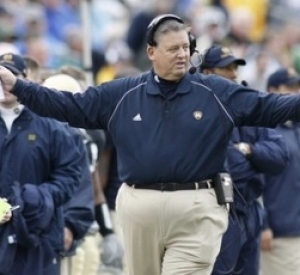
The Fighting Irish limped through their season finale against USC last Saturday. The game proved to be a resounding exclamation point to a dismal second-half season and sparked a frenzy of conjecture over the future of embattled head coach Charlie Weis.
Media pundits, Irish haters, and loyal fans all have opinions. The pundits compare his record to that of his predecessors as ample evidence to terminate his contract. The haters joke about wanting him to stay so the Irish will continue to be pushovers. And the loyal fans are left grasping for an explanation as to how the Irish went from the promising team Weis led in 2005 to the failures of 2007 and 2008.
In fairness to Weis, the 2007 debacle was a situation largely created by his predecessor, but so was the success of 2005, and last year’s team wouldn’t have been relegated to 3-9 without several gross coaching errors.
Measured against any objective criteria, Weis has failed. This is not an argument for or against his retention, but it is clear four years into his tenure that the ceiling of his coaching success is not congruent with the aspirations of Notre Dame.
There are a plethora of less talented teams that routinely perform at a higher level, and the youth and inexperience excuses are wearing extremely thin.
Next year may bring more wins for the Irish, but it will only serve to mask problems as another weak schedule awaits a very talented, albeit raw, team. The mistakes committed over the past 24 games are basic, fundamental, and repetitive, the last being the most inexcusable transgression.
Moreover, these repeated problems have combined to cause the players to lose confidence in Weis, something evident in the consistently lethargic and uninspired play of the Irish offense.
Searching for explanations has become a rote exercise in futility, but they are there. Four coaching deficiencies are responsible for Notre Dame’s poor play: the inability to motivate, a lack of execution, slow or negligible player development, and the absence of an effective running game.
Calling Matt Foley
For many Irish fans the most egregious error during Weis’ tenure is the team’s penchant for unemotional play. The frequency with which offensive linemen are beat by smaller, less talented players is barely palatable for those accustomed to the smash-mouth style of Lou Holtz and Joe Moore.
The most commonly offered culprit is motivation.
NFL players are motivated by money, fame, and prestige. College players are less mature, more impressionable, and in need of something or someone to consistently motivate them to play with passion.
It seems out of place given Weis’ opening press comments in which he declared that Notre Dame would have a “hard working, intelligent, nasty football team.” Additionally, the apathetic play of the 2008 squad comes on the heels of an off-season that saw Weis repeatedly challenge the players to play with more emotion.
The reality is that the Irish are anything but nasty, more aptly characterized by passive play. The enthusiastic, hard-nosed Weis that roamed the sidelines in 2005 and held his players accountable has been replaced by a docile, business-like coach trying to relate to a team chockfull of youth.
On multiple occasions Weis has mentioned the fragility of his team’s attitude, only to fail to successfully navigate their psyche. The result is slow starts, followed by timid play that quickly spirals out of control.
Weis’ inability to correct the emotional problems of his team while actively recognizing them is evidence of his inability to relate to younger players. This, combined with a cerebral coaching approach and finesse-based offense, all but negate the players’ inherent aggressiveness.
You Have To Walk Before You Can Run…Before You Can Pass
Weis’ offensive strategy, design, and play calling are extremely valuable in the NFL. With large amounts of time spent in practice, studying film, and adapting the offensive game plan from week-to-week, having a diverse playbook gives teams a distinct advantage.
It allows the offense to shift identities and attack in a variety of ways. With the complexities of NFL defenses, matching flexibility on the offensive side of the ball certainly has its reward.
But the 20-hour practice window of college football makes this a liability more than an asset. Weis doesn’t comprehend that a college offense needs an identity. The Irish would be better served building a core competency as its basic, primary weapon and expanding on it.
Additionally, the less developed players cannot handle the mental load requisite to execute a chameleon-like offense that seesaws from run-to-pass-to-run every week. Player progression is stymied, and the corresponding result is execution errors. Fundamentals are needed first, then technique, followed by repetition to perfect execution.
Waiting For Guffman, ‘er Development
More often than not, professional football players are fundamentally competent and technically sound. Neither can be taken for granted with college players.
College rosters are comprised of raw, talented athletes who may or may not become complete football players. Most outperformed their peers at the high school level via sheer athletic ability rather than football acumen. Thus, in order to develop, the players must benefit from good coaching tutelage.
Most of this falls on the staff as opposed to the head coach. However, the head coach is primarily responsible for practice regimen, and assigning disproportionate amounts of time to developing fundamentals is a grievous error.
Weis’ supporters will point to what he did in 2005 with Brady Quinn, Maurice Stovall, Anthony Fasano, and Jeff Samardzija. But these players are the integral pieces of a precision passing offense, Weis and his staff have yet to show he can develop offensive linemen or the pieces needed for an adept running game.
Additionally, these players already had at least two years under a previous coaching staff. When Weis was tasked with developing Quinn’s successor following the 2006 season, he completely mismanaged the situation, flirted with three different options, and finally inserted Jimmy Clausen in an effort to gain valuable game experience.
It Isn’t Always About Passing
Against the more talented defenses in the NFL an effective running game is nearly impossible to achieve. Each year a few teams manage a potent rushing attack, but the run is mostly a secondary weapon used to keep defenses honest.
This isn’t the case in college football where a running game is more advantageous against less athletic defenses.
There are fewer and less substantial adverse outcomes associated with running the ball. Moreover, the probability of said outcomes is far lower than in the passing game as running the ball is a considerably more facile proposition.
A running game controls the clock, takes pressure off the quarterback, and opens up the play-action pass. It creates favorable down-and-distances that result in better third down efficiency. It allows teams to move the ball on a short field, something that directly correlates to an increase in red zone scoring.
Finally, running the football is the simplest way to out-talent the opposition.
The fact that Notre Dame has spent the overwhelming part of 24 games unable to field a competent rushing attack speaks volumes to Weis’ coaching priorities and acumen, particularly after two off-seasons of proclaiming the Irish would be a run-heavy offense.
Whether he fails to realize the importance of running the football or is unable to successfully implement an effective rushing attack is irrelevant. The negative corollaries are readily apparent even to the most casual observer.
Summing It All Up
Weis’ NFL background is the common theme resonating through these four deficiencies, but while the overwhelming majority of his coaching experience occurred at the professional level, his lack of head coaching experience has also contributed to his failure.
This was never more evident than at the start of the 2007 season. Instead of anticipating the problems of a team brimming with youth, Weis made a series of coaching decisions that exacerbated the team’s weaknesses. In other words, he chose a complicated offensive scheme over execution predicated on simplicity.
Much of his coaching approach that was successful in 2005 contributed to the demise of the Irish in 2007. A more experienced college head coach may have prevented this.
Weis’ failure isn’t because he isn’t hard working, isn’t open and willing to change, doesn’t understand Notre Dame, can’t recruit, or isn’t an offensive guru. It also isn’t because of his ego. Despite popular opinion, confidence is a prerequisite for success in coaching.
Rather, his lack of head coaching experience prevented him from foreseeing the problems of the 2007 squad and his NFL background led him to believe he could out-scheme the opposition to compensate for them. The latter conspired to amplify the very problems inherent in a young and inexperienced team.
Both resulted in a loss of credibility and delay in player development the team still hasn’t recovered from, both underline the fact that learning on the job at Notre Dame is an extremely daunting task, and both directly contributed to his failure.
The forthcoming off-season will undoubtedly bring changes from Weis as a response to Notre Dame’s second-half season collapse. But the changes will be reactions to problems that surfaced this season rather than corrections to anticipated future challenges.
In other words, it will be more of the same.
For an inconsistent team more change begets more inconsistency, i.e. at some point the change creates more problems than it solves. The Irish are quickly reaching that point.
